[1]:
%load_ext lab_black
respyabc
Project for the course in Scientific Computing | Winter 2020/2021, M.Sc. Economics, Bonn University | `Manuel Huth < https://github.com/manuhuth>`__ |
In this notebook I showcase how to use the respyabc package, which builds on the pyabc and the respy package, to estimate the model first model from Keane and Wolpin 1994.
Emmanuel Klinger, Dennis Rickert, Jan Hasenauer (2018); pyABC: distributed, likelihood-free inference. Bioinformatics.
Janos Gabler, Tobias Raabe (2020); respy - A framework for the simulation and estimation of Eckstein-Keane-Wolpin models.
Using respyabc
Clone from GitHub or install via conda. For purposes of this notebook we recommend to download the repository from GitHub.
Loading all modules and functions is simply done by
[88]:
import respy as rp
import numpy as np
import pandas as pd

import time

from pyabc.visualization import plot_kde_matrix_highlevel
from pyabc.visualization import plot_model_probabilities
from respyabc.distances import compute_mean_squared_distance
from respyabc.evaluation import compute_point_estimate
from respyabc.evaluation import plot_2d_histogram
from respyabc.evaluation import plot_history_summary
from respyabc.evaluation import plot_history_summary_no_kde
from respyabc.evaluation import plot_kernel_density_posterior
from respyabc.evaluation import plot_multiple_credible_intervals
from respyabc.models import compute_model
from respyabc.models import transform_multiindex_to_single_index
from respyabc.respyabc import respyabc
from respyabc.tools import convert_time
from respyabc.tools import plot_normal_densities
# 1 From respy and pyABC to respyabc |
In this notebook I showcase the Python package respyabc, which offers a likelihood-free inference procedure for finite-horizon discrete choice models. The heart of respyabc are the two open-source packages respy (Gabler and Raabe; 2020) and pyABC (Klinger et al.; 2018]. We structured the notebook in the following way. First, we review the relevant theory that is needed to understand the presented analysis. Second, we showcase how single-parameter inference can be conducted by varying over the discount factor and using the activity’s relative choice frquencies \(a\) as well as the wage moments \(w\) as summary statistics. Subsequently, we conduct inference for the two constants \(\alpha_1, \alpha_2\) of the work equations \(R_1\) and \(R_2\) and afterwards for all non-zero equation parameters of the work equations. Before concluding, we show how respyabc can be used for model selection. We aim to explain all functionalities of respyabc within the analysis by giving code examples and explanations.
Let \(\tau \in \{0, \dotsc, T \}\) be a finite number of periods in which an individual \(i \in I\) decides between working in occupation A (\(a=1\)) or B (\(a=2\)), schooling (\(a=3\)) and staying at home (\(a=4\)). For each decision an individual receives a choice-specific reward \(R_a\) with
\begin{align} R_1(\tau) &= w_{1\tau}=\exp{\left(\alpha_1 + \beta_{11} h_\tau + \gamma_{11} k_{1\tau} + \gamma_{12} k_{1\tau}^2 + \gamma_{17} k_{2\tau} + \gamma_{18} k_{2\tau}^2 + \varepsilon_{1\tau} \right)} \\ R_2(\tau) &= w_{2\tau} = \exp{\left(\alpha_2 + \beta_{21} h_\tau + \gamma_{21} k_{2\tau} + \gamma_{22} k_{2\tau}^2 + \gamma_{27} k_{1\tau} + \gamma_{28} k_{1\tau}^2 + \varepsilon_{2\tau} \right)} \\ R_3(\tau) &= \alpha_3 + \beta_{hc} \mathbb{I}(h_\tau \geq 12) + \beta_{rc}[1-\mathbb{I}(a_{\tau-1} = 3)] + \varepsilon_{3\tau} \\ R_4(\tau) &= \alpha_4 + \varepsilon_{4\tau}. \end{align}
\begin{align} v_\tau(s_\tau) = \mathbb{E} \left[\sum_{j=0}^{T-\tau} \delta^j u_{\tau+j}\left[s_{\tau+j}, a_{\tau+j}(s_{\tau+j})\right] \mid s_\tau \right], \end{align} where \(s_\tau\) is the given state in period \(\tau\) and \(\delta \in (0,1]\) the discount factor. The solution implemented in respy is to solve the optimization problem via dynamic programming and the use of value fucntions (Bellmann; 1952). With respy the user can calibarate her model by using empirical or simulated data of independent individuals via maximum likelihood estimation and estimation via the method of simulated moments. respyabc offers a likelihood-free alternative via approximate Bayesian computing (ABC) using a sequential Monte-Carlo (SMC) scheme. This is implemented by using pyABC. To go into more detail of pyABC we first introduce some notation and define summary statistics for observed/simulated data that we use within the analysis.
- For inference purposes we are interested in the likelihood of a parameter vector given observed data \(Y^{(q)}\). This likelihood is reflected by the posterior distribution \(p(\theta|Y^{(q)})\). We can describe the posterior distribution in terms of the likelihood \(f(Y^{(q)}| \theta)\) and the prior distribution \(\pi(\theta)\) :nbsphinx-math:`begin{align}
p(theta|Y^{(q)}) = frac{f(Y^{(q)}| theta) pi(theta) }{int f(Y^{(q)}| theta’) pi(theta’) dtheta’} propto f(Y^{(q)}| theta) pi(theta) .
end{align}`
For complex \(\mathcal{M}^{(q)}\) the posterior might be too complicated or not traceable at all. In these cases we can use ABC to estimate parameters likelihood-free. The idea is to sample parameters \(\theta\) such that the simulated model output \(\hat{Y}^{(q)}\) is close to the observed data \(Y^{(q)}\). For computational convenience, we do not use the data of \(Y^{(q)}\) and \(\hat{Y}^{(q)}\) but their summary statistics \(S^{(q)}\) and \(\hat{S}^{(q)}\) instead to measure closeness of the data. For individuals in the sense of the KW94 model their order in the population, e.g. which individual is placed in which column of \(Y^{(q)}\), is redundant and we need to use a ‘sample location’ which is invariant to the ordering. This is the case for our summary statistics \(a\) and \(w\) since they are computed using first and second moments.
To define what being close means for two matrices of summary statistics we need to define a suitable distance \(d^{(q)}:\mathbb{R}^{(T+1) \times \zeta^{(q)}} \times \mathbb{R}^{(T+1) \times \zeta^{(q)}} \to \mathbb{R_+}\). In our application, we use the averaged squared Frobenius-Norm of the differences between both matrices, which is just the mean of the squarred differences in each cell of the summary matrices. A simulated output \(\hat{Y}_j^{(q)}\) is defined to be close to \(Y^{(q)}\) if \(d(S^{(q)}, \hat{S}_j^{(q)}) < \epsilon\) for a fixed small \(\epsilon > 0\).
- :nbsphinx-math:`begin{align}
p(theta|S^{(q)}) = frac{f(S^{(q)}| theta) pi(theta) }{p(S^{(q)})} approx frac{int f(S| theta) pi(theta) mathbb{I}left[d(S^{(q)},S) < epsilon right] dS}{p(S^{(q)})} = p_epsilon(theta|S^{(q)}),
end{align}` such that \(\lim\limits_{\epsilon \to 0} p_\epsilon(\theta|S^{(q)}) = p(\theta|S^{(q)})\).
Initialize run. 1.1 Draw candidates \(\hat{\theta}_{0j}\) unconditionally from the prior distribution \(\pi(\theta)\) and accept if \(d^{(q)}\left(\hat{S}_{0j}^{(q)}, S^{(q)}\right) < \epsilon_0\). Repeat until \(p_0\) simulations have been accepted and set them as initial population \(\hat{\theta}_0 = \left\{\hat{\theta}_{01}^{(q)}, \dotsc, \hat{\theta}_{0p_0}^{(q)} \right\}\). 1.2 Set weights \(\omega_{0j} = 1/p_0\)
Set \(\epsilon_1\) to the median distance of the previous population. 2.1 Sample \(\hat{\theta}_{1j}\) from \(\hat{\theta}_0\) with weights \(\omega_0\) and perturb it with a perturbation kernel \(K_1\) (see Toni et al. (2008)). Accept if \(d^{(q)}\left(\hat{S}_{1j}^{(q)}, S^{(q)}\right) < \epsilon_1\). Repeat until \(p_1\) simulations have been accepted and set them as population \(\hat{\theta}_1 = \left\{\hat{\theta}_{11}^{(q)}, \dotsc, \hat{\theta}_{1p_1}^{(q)} \right\}\). 2.2 Set weights to \(\omega'_{1j} = \frac{\pi(\theta_{1j})}{\sum_{j=1}^{p_1} \omega_{0j} K_1\left(\theta_{1j}, \theta_{0j}\right)}\) and normalize them such that their sum equals one to obtain \(\omega_{1j}\).
Proceed with the same procedure until the \(n\)-th population \(\hat{\theta}_n = \left\{\hat{\theta}_{n1}^{(q)}, \dotsc, \hat{\theta}_{np_n}^{(q)} \right\}\) is simulated using \(\epsilon_n\).
In respyabc the user needs to define \(\epsilon_n\), which is to say, the minimum epsilon and therefore the acceptance threshold. The acceptance rate is off course very sensitive to the choice of \(\epsilon_n\). On the one hand, if \(\epsilon_n\) is too large the approximation error is too high and we tend to accept samples generated by parameters that are far away from the true ones. On the other hand, if \(\epsilon_n\) is too small, we might decline too many samples and the algorithm has a hard time computing estimates.
After reviewing the theory, let’s get started with the application of respyabc!
KW94model settings
We use respy to load the settings of the KW94 model and inspect the true parameter we use to get on overview of the magnitudes we vary over. If desired, the user can use params to get a glimpse on how the parameters look like. For readability, we refrain from showing the parameters in params in the standard notebook.
[89]:
params, options, data_stored = rp.get_example_model("kw_94_one")
To run respyabc efficiently, it is necessary that the distance \(d^{(q)}(\cdot)\) we observe is (close to) zero if we simualte the model with the true parameter vector \(\theta\). Hence, we want that \(\mathcal{M}^{(q)}(\theta)=S^{(q)}\) is invariant to the choice of the random simulation seed. We achieve this in the KW94 setting by choosing a suitable large number of individuals and decision periods, such that the summary statistics are invariant to the seeds. We keep the standards of \(T=40\) simulated periods and \(|I|=1000\) individuals for each run of the KW94 model.
[90]:
periods = options["n_periods"]
agents = options["simulation_agents"]
f"The KW94 model consists of {periods} periods and {agents} agents."
[90]:
'The KW94 model consists of 40 periods and 1000 agents.'
# 2 Inference |
2.1 Using a single parameter
In this subsecton we vary over the discount factor delta, which is in the KW94 model set to \(\delta = 0.95\) such that the model of interest becomes \(\mathcal{M}^{(q)}(\delta)=S^{(q)}\). We compare how respyabc performs for both types of summary statistics \(q=a,w\).
To simulate the true population in respyabc we need to define the model that is to be simulated and choose between \(d^{(a)}(\cdot)\) and \(d^{(w)}(\cdot)\) to compute the distance between 2 populations. Naming the parameter delta_delta seems to be unnecassarily cumbersome in the first place. However, note that params is a multi-indexed data frame but pyABC only works with single-indexed data frames. Thus, respyabc melts both indices to an index and divides them by an underscore,
such that the parameter key and the data frame index can be called within one string but the parameter is still uniquely identified in params. The parameters are, according to pyABC, defined in a dictionary. Note that we do not need to pass the parameter of interest as additional argument for simulating the data since we use the default value that is already defined in params. We do so, however, to showcase the user how changing the reference data set can be implemented.
[91]:
model_to_simulate = rp.get_simulate_func(params, options)
parameter_true_single_delta_a = {"delta_delta": 0.95}
2.1.1 Using choice frequencies
In this first example we use \(q=a\). We can pass this to respyabc by specifying descriptives="choice_frequencies". Moreover, respyabc allows to modify the parameter values over which we do not vary and the custom options. Note that settings in parameter_for_simulation are overwritten by setting the true parameter through the dictionary parameter_true_single_delta_a. We distinguish between varying and fixed parameters since the function compute_model is used within the
ABC_SMC scheme. We set the parameters and options of the model to the to their default values by spassing parameter_for_simulation=params and options_for_simulation=options to the function.
Setting up the data
[92]:
np.random.seed(12)
pseudo_observed_data_a = compute_model(
    parameter_true_single_delta_a,
    model_to_simulate=model_to_simulate,
    parameter_for_simulation=params,
    options_for_simulation=options,
    descriptives="choice_frequencies",
)
To varify that \(\mathcal{M}^{(q)}(\delta)\) is invariant to the random seed, we run the simulation again using a different seed.
[93]:
np.random.seed(123)
pseudo_observed_data_a_test = compute_model(
    parameter_true_single_delta_a,
    model_to_simulate=model_to_simulate,
    parameter_for_simulation=params,
    options_for_simulation=options,
    descriptives="choice_frequencies",
)
We can compare two distances by using the mean squared difference between both matrices of summary statistics.
[94]:
seed_distance_a = compute_mean_squared_distance(
    pseudo_observed_data_a_test, pseudo_observed_data_a
)
f"The distance is: {seed_distance_a :0.2f}"
[94]:
'The distance is: 0.00'
[95]:
population_size = 500
max_nr_populations = 10
\(\epsilon_n\) is set to be 0.05. This was found to be a valid epsilon in previous simulations. We choose a uniform prior \(\delta \sim U(\cdot)\). Choosing a uniform prior has the advantage that the user sets the distribution bounds as bounds for the posterior distribution, yielding more control on which values to allow. This is especially useful for the discount parameter which we expect to be smaller than or equal to one. Specifying priors must be done in a dictionary with the
parameter name corresponding to the multiindex of params as key and a list containing another list that specifies the distribution parameters and the type of the distribution. Currently, only the uniform distribution ("uniform") and the normal distribution ("norm") are implemented. We show a usecase of normal priors within the model selection chapter.
[96]:
minimum_epsilon = 0.05
delta_prior_low_single_delta_a = 0.9
delta_prior_length_single_delta_a = 0.09
parameters_prior_single_delta_a = {
    "delta_delta": [
        [delta_prior_low_single_delta_a, delta_prior_length_single_delta_a],
        "uniform",
    ]
}
"delta_delta" is the key identifier, delta_prior_low_single_delta_a is the lower bound of the uniform distribution and delta_prior_length_single_delta_a is the length of the uniform interval and not its upper bound. We chose this type setting of the uniform distribution in order to be in line with pyABC, which follows scipy.
After specifying all relevant parameters, inference is conducted by using the respyabc function. To run the fucntion we need to specify model \(\mathcal{M}^{(q)}\) by model, define the prior distribution \(\pi(\delta)\) by parameters_prior, the true data \(S^{(q)}\) by data, the distance measure \(d^{(q)}\) by compute_mean_squared_distance, the type of descriptive statistics \(q\) by descriptives, the first population size \(p_0\) by
population_size_abc, the maximum number of populations by max_nr_populations_abc and \(\epsilon_n\) by minimum_epsilon_abc.
distance_abc, descriptives, population_size and minimum_epsilon are the default values of respyabc. We do specify them in this firste example to showcase how they must be specified and in subsequent functions to allow easy changes over the whole notebook by just changing the relevant names of the objects that are passed to the respective
arguments of the function.[11]:
np.random.seed(1234)
start_single_delta_a = time.perf_counter()
history_single_delta_a = respyabc(
    model=compute_model,
    parameters_prior=parameters_prior_single_delta_a,
    data=pseudo_observed_data_a,
    distance_abc=compute_mean_squared_distance,
    descriptives="choice_frequencies",
    population_size_abc=population_size,
    max_nr_populations_abc=max_nr_populations,
    minimum_epsilon_abc=minimum_epsilon,
)
end_single_delta_a = time.perf_counter()
[97]:
time_single_delta_a, unit_single_delta_a = convert_time(
    end_single_delta_a - start_single_delta_a
)
f"The respyabc run took {time_single_delta_a:0.2f} {unit_single_delta_a}"
[97]:
'The respyabc run took 35.17 minutes'
compute_point_estimate function by simply passing the created history object history_single_delta_a.[98]:
estimate_single_delta_a = compute_point_estimate(history_single_delta_a).loc[
    "estimate", "delta_delta"
]
f"The point estimate for delta is: {estimate_single_delta_a:0.4f}"
[98]:
'The point estimate for delta is: 0.9502'
[99]:
rel_bias_delta_a = (
    estimate_single_delta_a / parameter_true_single_delta_a["delta_delta"] - 1
)
f"The relative bias for delta is: {rel_bias_delta_a *100:0.4f}%"
[99]:
'The relative bias for delta is: 0.0215%'
plot_kernel_density_posterior.Figure 1 - Univariate kernel density estimates of the posterior using relative choice frequencies
[100]:
xmax_single_delta_a = delta_prior_low_single_delta_a + delta_prior_length_single_delta_a
plot_kernel_density_posterior(
    history=history_single_delta_a,
    parameter="delta_delta",
    xmin=delta_prior_low_single_delta_a,
    xmax=xmax_single_delta_a,
)
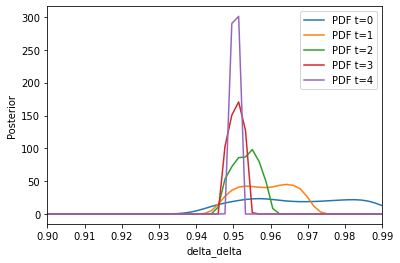
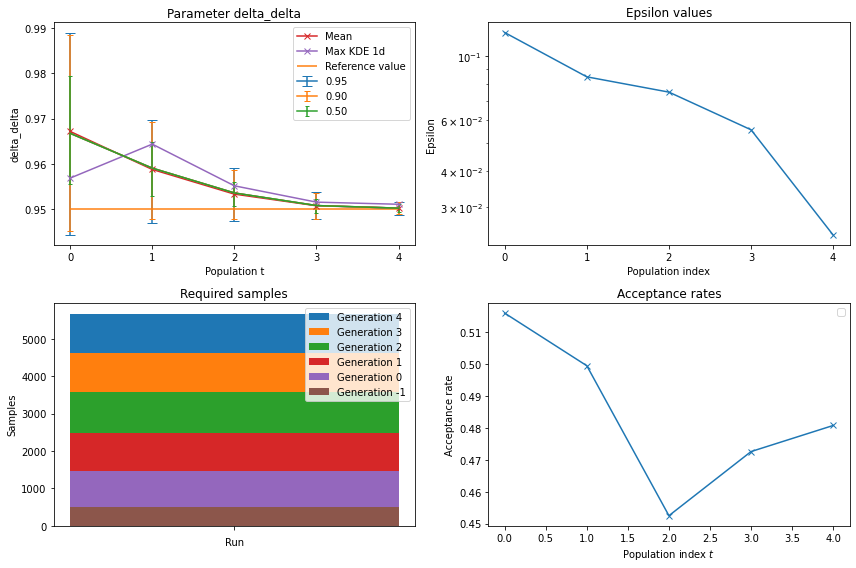
respyabc returns a ABCSMC class, all model assessments tools from pyABC are feasible to apply as well. Hence, we can use the well implemented functions to track the evolution of \(\epsilon_t\), the \(p_t\) and plot credible intervals. respyabc offers a wrapper
plot_history_summary for a fast implementation that only requires the history, parameter name and the reference value.Figure 2 - Single-parameter model evaluation using choice frequencies
[101]:
plot_history_summary(
    history=history_single_delta_a, parameter_name="delta_delta", parameter_value=0.95
)
2.1.2 Using wage moments
In the next step, we conduct the same analysis varying over \(\delta\) but choose \(q=w\). To use the wage moments, we first need to compute the exemplary data set with the wage moments as summary statistics. We can do so by setting descriptives="wage_moments". All other parameters are equal to the specififcation using \(q=a\). We set the same seed to obtain the same data. As done in the previous analysis, we compare the distance for two seeds to see if the summary statistics are
invariant to the choice of the seed.
[102]:
np.random.seed(12)
pseudo_observed_data_single_delta_w = compute_model(
    parameter_true_single_delta_a,
    model_to_simulate=model_to_simulate,
    parameter_for_simulation=params,
    options_for_simulation=options,
    descriptives="wage_moments",
)
np.random.seed(123)
pseudo_observed_data_single_delta_w_test = compute_model(
    parameter_true_single_delta_a,
    model_to_simulate=model_to_simulate,
    parameter_for_simulation=params,
    options_for_simulation=options,
    descriptives="wage_moments",
)
[103]:
seed_distance_single_delta_w = compute_mean_squared_distance(
    pseudo_observed_data_single_delta_w_test, pseudo_observed_data_single_delta_w
)
f"The distance is: {seed_distance_single_delta_w :0.2f}"
[103]:
'The distance is: 0.00'
data=pseudo_observed_data_single_delta_w and the type of summary statistics by descriptives="wage_moments". Moreover, since the magnitudes of the wage moments are comparably high, we set \(\epsilon_n=10^6\) which turned out to be a reasonable magnitude.[18]:
np.random.seed(1234)
start_single_delta_w = time.perf_counter()
history_single_delta_w = respyabc(
    model=compute_model,
    parameters_prior=parameters_prior_single_delta_a,
    data=pseudo_observed_data_single_delta_w,
    distance_abc=compute_mean_squared_distance,
    descriptives="wage_moments",
    population_size_abc=population_size,
    max_nr_populations_abc=max_nr_populations,
    minimum_epsilon_abc=10 ** 6,
)
end_single_delta_w = time.perf_counter()
[104]:
time_single_delta_w, unit_single_delta_w = convert_time(
    end_single_delta_w - start_single_delta_w
)
f"The respyabc run took {time_single_delta_w:0.2f} {unit_single_delta_w}"
[104]:
'The respyabc run took 48.34 minutes'
[105]:
estimate_single_delta_w = compute_point_estimate(history_single_delta_w).loc[
    "estimate", "delta_delta"
]
f"The point estimate for delta is: {estimate_single_delta_w:0.4f}"
[105]:
'The point estimate for delta is: 0.9500'
[106]:
rel_bias_delta_w = (
    estimate_single_delta_w / parameter_true_single_delta_a["delta_delta"] - 1
)
f"The relative bias for delta is: {rel_bias_delta_w*100:0.4f}%"
[106]:
'The relative bias for delta is: 0.0030%'
Figure 3 - Univariate kernel density estimates of the posterior using wage moments
[107]:
xmax_single_delta_a = delta_prior_low_single_delta_a + delta_prior_length_single_delta_a
plot_kernel_density_posterior(
    history=history_single_delta_w,
    parameter="delta_delta",
    xmin=delta_prior_low_single_delta_a,
    xmax=xmax_single_delta_a,
)
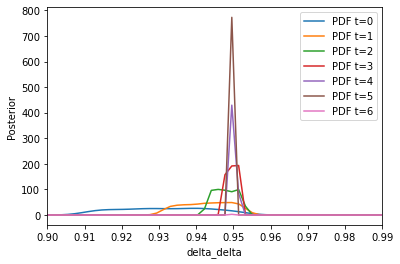
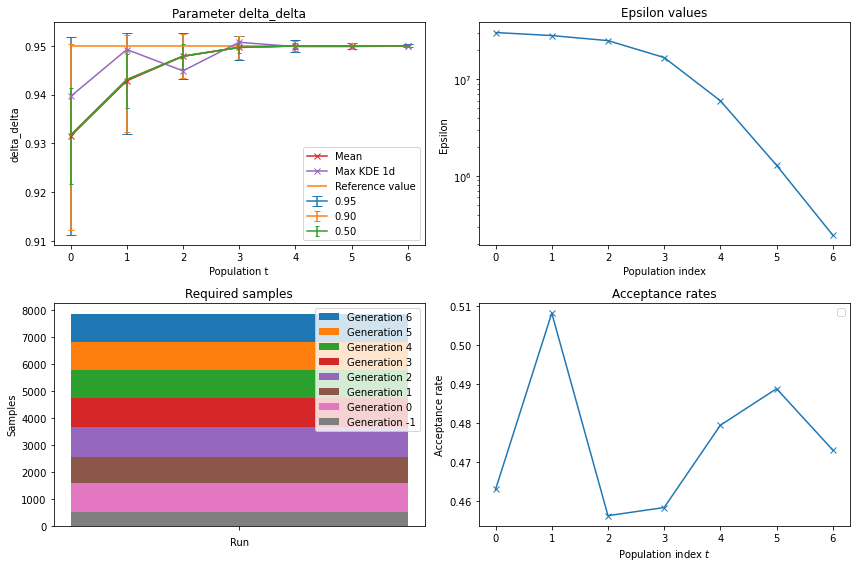
Further summary statistics underline our findings. The mean estimator is already at the second population very accurate and smoothes even closer to the true value for higher \(t\). The trajectory of the epsilons and the acceptance rates look similar to the plots using the choice frequencies.
Figure 4 - Single-parameter model evaluation using wage moments
[108]:
plot_history_summary(
    history=history_single_delta_w, parameter_name="delta_delta", parameter_value=0.95
)
2.2 Multiple parameters
In this subsection we extend the analysis and vary over multiple parameters. First, we use the wage constants such that \(\theta = \begin{pmatrix} \alpha_1 & \alpha_2 \end{pmatrix}'\) and second we use all non-zero parameters of the work equations. We only use choice frequencies as summary statistics in his chapter. Extensions to using the wage moments can be done simultaneously to the single parameter case by changing the respective string to “wage_moments”.
2.2.1 Two parameters
We first vary over two parameters to showcase the transition from a single parameter model to a multiple parameter model. Our parameters of choice are the constants \(\alpha_1\) and \(\alpha_2\) from equations \(R_1\) and \(R_2\) such that the model becomes \(\mathcal{M}^a(\alpha_1, \alpha_2)\). Note that for a rigorous comparison between a single and a two-parameter model, we would need to compare both single parameter models of \(\alpha_1\) and \(\alpha_2\) with their respective two-parameter model. We refrain from doing so since we want to keep the notebook concise and this would require conducting the same analysis four times. Thus, we decided to use the work specific constants in the two-parameter case.
params and the values equal to the desired magnitude. We choose again unform priors \(\alpha_1 \sim U(\cdot)\) and \(\alpha_2 \sim U(\cdot)\).[109]:
parameters_prior_multi_alpha = {
    "wage_a_constant": [[9, 1], "uniform"],
    "wage_b_constant": [[8, 1], "uniform"],
}
respyabc with multiple parameters is equivalent to the previous single parameter chapter.[24]:
np.random.seed(234)
start_multi_alpha = time.perf_counter()
history_multi_alpha = respyabc(
    model=compute_model,
    parameters_prior=parameters_prior_multi_alpha,
    data=pseudo_observed_data_a,
    distance_abc=compute_mean_squared_distance,
    descriptives="choice_frequencies",
    population_size_abc=population_size,
    max_nr_populations_abc=max_nr_populations,
    minimum_epsilon_abc=minimum_epsilon,
)
end_multi_alpha = time.perf_counter()
[110]:
time_multi_alpha, unit_multi_alpha = convert_time(end_multi_alpha - start_multi_alpha)
f"The respyabc run took {time_multi_alpha:0.2f} {unit_multi_alpha}"
[110]:
'The respyabc run took 35.84 minutes'
[111]:
estimate_multi_alpha = compute_point_estimate(history_multi_alpha).loc["estimate", :]
estimate_multi_alpha
[111]:
name
wage_a_constant    9.406300
wage_b_constant    8.688667
Name: estimate, dtype: float64
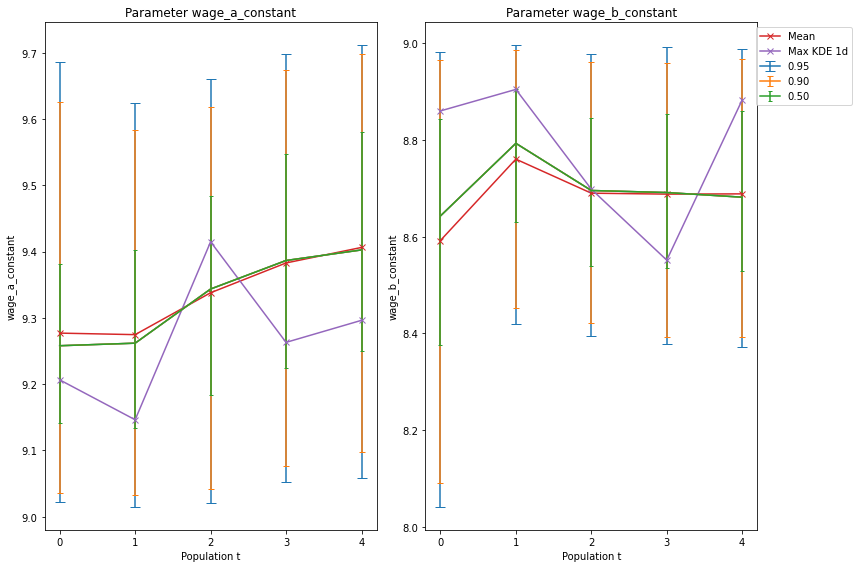
The absolut and the relative biases are considerably larger as for the \(\delta\) parameter.
[112]:
true_wage_a_constant = params.loc["wage_a", "constant"]["value"]
true_wage_b_constant = params.loc["wage_b", "constant"]["value"]
true_wage_constants = np.array([true_wage_a_constant, true_wage_b_constant])
rel_bias_two = (np.array(estimate_multi_alpha) / true_wage_constants - 1) * 100
df_rel_bias_two = pd.DataFrame(
    data=rel_bias_two, index=estimate_multi_alpha.index, columns=["relative bias in %"]
)
df_rel_bias_two
[112]:
| relative bias in % | |
|---|---|
| name | |
| wage_a_constant | 2.131383 |
| wage_b_constant | 2.460694 |
Figure 5 - Two-parameter credibility intervals
[113]:
plot_multiple_credible_intervals(
    history=history_multi_alpha,
    number_rows=1,
    number_columns=2,
    parameter_names=["wage_a_constant", "wage_b_constant"],
)
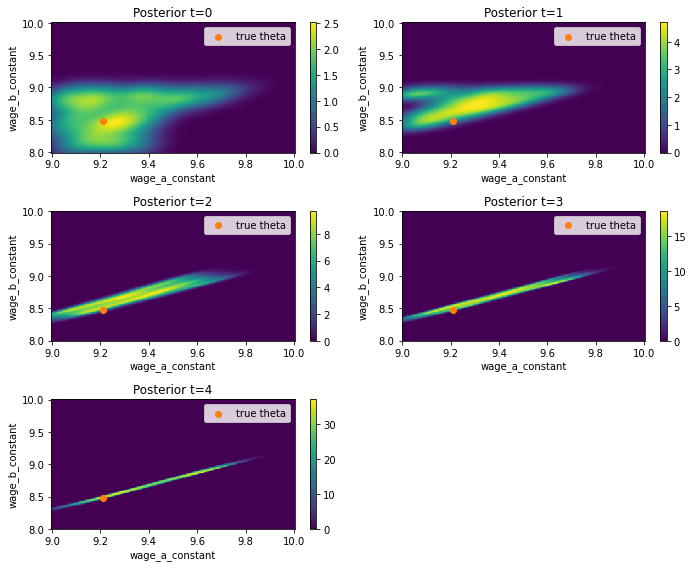
For the kernel densities, we do not only exploit their univariate but their bivariate structure. The graph below indicates the bivariate kernel density estimates of the posterior for all simulated populations, using a multivariate normal kernel. The orange dot is the location of the true parameter values. The color scheme indicates the value of the estimated bivariate density function. As for the single parameter case, we observe that for increasing \(t\), the density’s variance becomes lower. In the last graph \(t=4\) we can observe that there is a line-like area with a high density that has the true value more to its left surface. The estimated mean point \((9.41, 8.67)'\) lies in the middle of that colored line area. The intuition could be that we compute the estimates as weighted average over the sample and thus we end up with the center point of the area containing the high densities.
[ ]:
xmin = parameters_prior_multi_alpha["wage_a_constant"][0][0]
xmax = xmin + parameters_prior_multi_alpha["wage_a_constant"][0][1]
ymin = parameters_prior_multi_alpha["wage_b_constant"][0][0]
ymax = xmin + parameters_prior_multi_alpha["wage_b_constant"][0][1]
Figure 6 - Bivariate kernel density estimates of the posterior
[114]:
plot_2d_histogram(
    history=history_multi_alpha,
    parameter_names=["wage_a_constant", "wage_b_constant"],
    parameter_true=[9.21, 8.48],
    xmin=xmin,
    xmax=xmax,
    ymin=ymin,
    ymax=ymax,
)
/home/manuel/Documents/respyabc/respyabc/evaluation.py:462: MatplotlibDeprecationWarning: Passing non-integers as three-element position specification is deprecated since 3.3 and will be removed two minor releases later.
  ax = fig.add_subplot(3, ncol, t + 1)
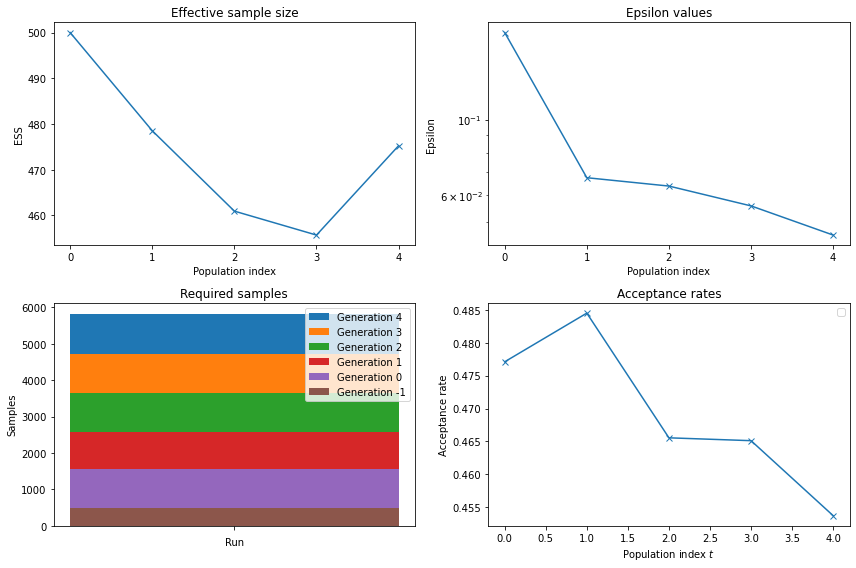
Additionally to the previous model summaries, respyabc offers to plot the effective sample size \(p_t\). We offer a short cut by offering all four plots below in one function plot_history_summary_no_kde. The \(\epsilon_t\) values and the acceptance rates show different trajectories as in the single parameter case. Especially the value of \(\epsilon_t\) decreases for \(t=0\) to \(t=1\) rapidly but smoothly afterwards. This smooth descend indicates that the distance between
the estimated samples \(\hat{Y}^{(a)}\) and the true sample \(Y^{(a)}\) decreases slower as for the single parameter example.
Figure 7 - Two-parameter model evaluation
[115]:
plot_history_summary_no_kde(history_multi_alpha)
describe plots
2.2.2 All non-zero parameters
The transition from a two-parameter model to a multiple parameter model is straightforward. The user simply needs to extend the steps of indicating the desired number of parameters instead of two parameters. In this example we vary over all parameters of the wage equations \(R_1\) and \(R_2\) that are non-zero in the KW94 specification and the discount factor. We stay within the activity’s choice frequency framework \(q=a\) and set the parameter vector of interest to \(\theta = \begin{pmatrix} \delta & \alpha_1 & \beta_{11} & \gamma_{11} & \gamma_{12} & \alpha_2 & \beta_{21} & \gamma_{21} & \gamma_{22} & \gamma_{27} & \gamma_{28} \end{pmatrix}'\).
[116]:
parameters_prior_multi = {
    "delta_delta": [
        [delta_prior_low_single_delta_a, delta_prior_length_single_delta_a],
        "uniform",
    ],
    "wage_a_constant": [
        [
            parameters_prior_multi_alpha["wage_a_constant"][0][0],
            parameters_prior_multi_alpha["wage_a_constant"][0][1],
        ],
        "uniform",
    ],
    "wage_a_exp_edu": [[0, 0.1], "uniform"],
    "wage_a_exp_a": [[0, 0.1], "uniform"],
    "wage_a_exp_a_square": [[-0.05, 0.05], "uniform"],
    "wage_b_constant": [
        [
            parameters_prior_multi_alpha["wage_b_constant"][0][0],
            parameters_prior_multi_alpha["wage_b_constant"][0][1],
        ],
        "uniform",
    ],
    "wage_b_exp_edu": [[0, 0.1], "uniform"],
    "wage_b_exp_b": [[0, 0.1], "uniform"],
    "wage_b_exp_b_square": [[-0.05, 0.05], "uniform"],
    "wage_b_exp_a": [[0, 0.1], "uniform"],
    "wage_b_exp_a_square": [[-0.05, 0.05], "uniform"],
}
respyabc does not change for more multi-parameter settings after we have specififed the priors and are happy to keep the same settings as in the previous analysis.[31]:
np.random.seed(2345)
start_multi = time.perf_counter()
history_multi = respyabc(
    model=compute_model,
    parameters_prior=parameters_prior_multi,
    data=pseudo_observed_data_a,
    distance_abc=compute_mean_squared_distance,
    descriptives="choice_frequencies",
    population_size_abc=population_size,
    max_nr_populations_abc=max_nr_populations,
    minimum_epsilon_abc=minimum_epsilon,
)
end_multi = time.perf_counter()
[117]:
time_multi, unit_multi = convert_time(end_multi - start_multi)
f"The respyabc run for delta using choice frequencies took {time_multi:0.2f} {unit_multi}"
[117]:
'The respyabc run for delta using choice frequencies took 1.81 hours'
[118]:
estimate_multi = compute_point_estimate(history_multi).loc["estimate", :]
estimate_multi
[118]:
name
delta_delta            0.931159
wage_a_constant        9.514182
wage_a_exp_a           0.045997
wage_a_exp_a_square   -0.017593
wage_a_exp_edu         0.052689
wage_b_constant        8.783145
wage_b_exp_a           0.064983
wage_b_exp_a_square   -0.004419
wage_b_exp_b           0.062015
wage_b_exp_b_square   -0.002937
wage_b_exp_edu         0.065745
Name: estimate, dtype: float64
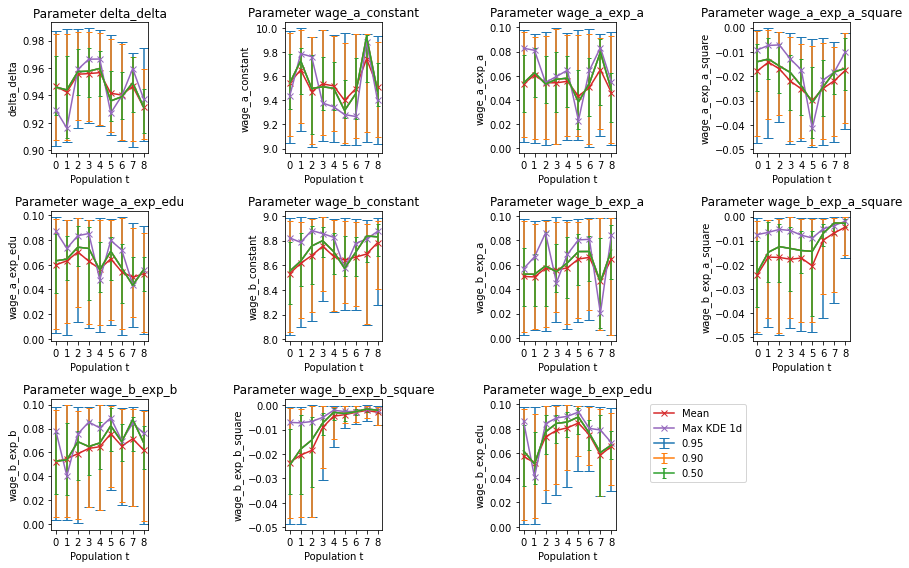
The relative biases are considerably high, especially for the parameters responsible for the downward parabola shape. These parameters are, however, low in magnitude and therefore show high relative biases while having comparable low absolute biases.
[119]:
params_single_index = transform_multiindex_to_single_index(params, "category", "name")
true_parameter_multi = np.array(params_single_index.loc[estimate_multi.index]["value"])
rel_bias_multi = (np.array(estimate_multi) / true_parameter_multi - 1) * 100
df_rel_bias_multi = pd.DataFrame(
    data=rel_bias_multi, index=estimate_multi.index, columns=["relative bias in %"]
)
df_rel_bias_multi
[119]:
| relative bias in % | |
|---|---|
| name | |
| delta_delta | -1.983245 |
| wage_a_constant | 3.302736 |
| wage_a_exp_a | 39.383554 |
| wage_a_exp_a_square | 3418.503946 |
| wage_a_exp_edu | 38.654182 |
| wage_b_constant | 3.574824 |
| wage_b_exp_a | 195.376200 |
| wage_b_exp_a_square | 783.862434 |
| wage_b_exp_b | -7.440788 |
| wage_b_exp_b_square | 193.728749 |
| wage_b_exp_edu | -6.078182 |
Figure 8 - Multi-parameter credibility intervals
[120]:
par_names = estimate_multi.index
plot_multiple_credible_intervals(
    history=history_multi,
    parameter_names=par_names,
    number_rows=3,
    number_columns=4,
    delete_axes=[2, 3],
    legend_location="lower_right",
)
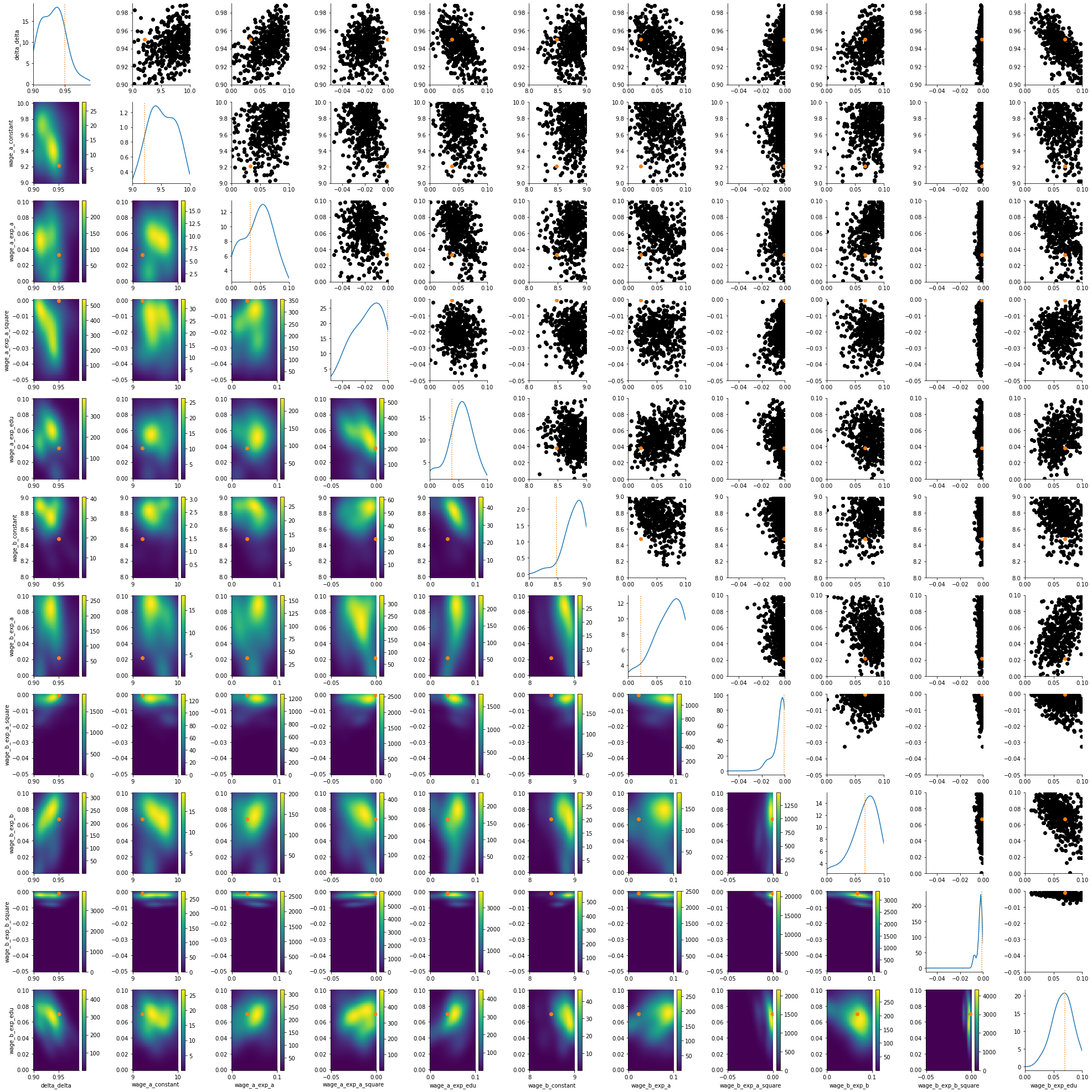
Similar to the two parameter case we plot the bivariate kernel density estimates but only for \(t=n\). They are depicted in the lower triangle of the plot matrix. The upper triangle contains the unweighted bivariate scatter plots of the final samples \(\hat{\theta}_n\). The orange dot is the true parameter point. The main diagonal depicts the marginal kernel density estimates. all axes are rstricted to the parameter bounds set by the uniform priors. We observe that the true points are
accurately captured by the biavriate kernel densities of the posteriors. However, for some parameters like \(\gamma_{27}\) ("wage_b_exp_a") we observe some constantd eviation from the true points across all bivariate distributions. This finding is in line with the high relative bias of the point estimate. Nethertheless, most other parameters that have a high relative bias seem to be well reflected by the bivariate posterior kernel density estimates.
[ ]:
true_values = {}
count = 0
for i in estimate_multi.index:
    true_values[i] = true_parameter_multi[count]
    count += 1

limits = {}
keys = parameters_prior_multi.keys()
for i in keys:
    limits[i] = (
        parameters_prior_multi[i][0][0],
        parameters_prior_multi[i][0][0] + parameters_prior_multi[i][0][1],
    )
Figure 9 - Univariate and Bivariate kernel density estimates of the posteriors
[121]:
kde_matrix = plot_kde_matrix_highlevel(history_multi, refval=true_values, limits=limits)
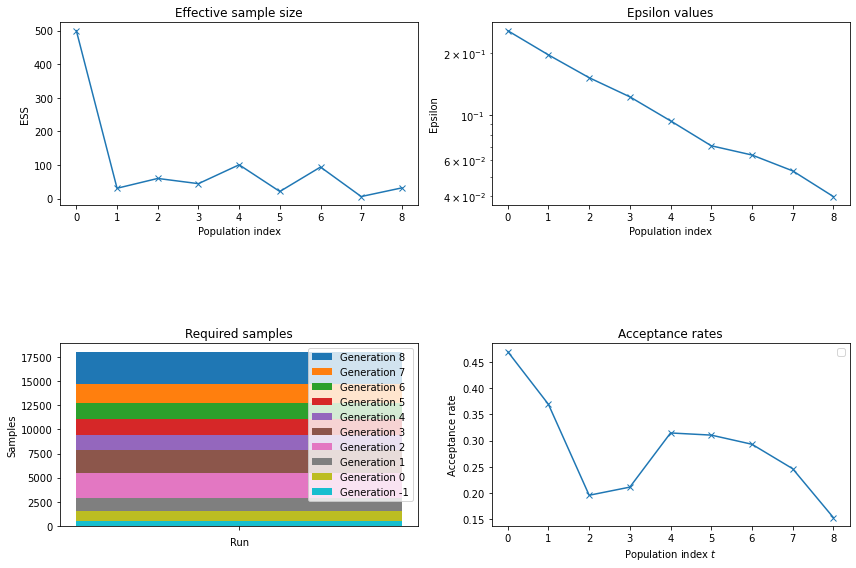
The trajectory of \(\epsilon_t\) is close to a straight line and the acceptance rate shows a similar structure as for the single parameter case. The sample sizes decrease rapidly to around 50-100 after the first population. This reduction is liklely to have reduced the time of the ABC-SMC algorithm remarkably and indicates that we could consider a lower population size for the multi-parameter setting.
Figure 10 - Multi-parameter model evaluation
[122]:
plot_history_summary_no_kde(history_multi)
# 3 Model selection
As closing example, we give a brief example on how respyabc can be ueed for model selection. To do so we compare two KW94 models that are actually identical but differ in their prior distribution. As prior we now use normal distributions. Defining the models to compare can be done by defining two models in one list. For an inside to the theory behind model selection we point to Toni et al. (2008).
[123]:
models = [compute_model, compute_model]
We need to define an exemplary parameter to vary over. Our first choice would be the discount factor \(\delta\) which, as explained in the single parameter chapter, should be estimated with a uniform prior. However, for purposes of showing how model selection works it is more suitable to use normal priors instead of uniform priors since the latter rather serve as setting bounds over a equally likely grid. Hence, we decided to use \(\beta_{11}\), that is the influence of education on the wages in occupation one.
[124]:
parameter_selection = "wage_a_exp_edu"
mu0 = params.loc["wage_a", "exp_edu"][0] * 1
var0 = 0.004
mu1 = params.loc["wage_a", "exp_edu"][0] * 0.6
var1 = 0.004
To specify the priors the user specifies a prior dictionary for each model, as done previously for parameter inference, and defines one list containing both prior dictionaries.
[125]:
parameter_prior_selection_model0 = {parameter_selection: [[mu0, var0], "norm"]}
parameter_prior_selection_model1 = {parameter_selection: [[mu1, var1], "norm"]}
parameter_prior_selection = [
    parameter_prior_selection_model0,
    parameter_prior_selection_model1,
]
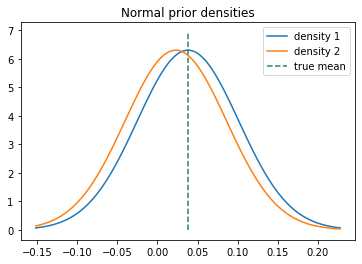
We plot the density of the priors along with the true value. The prior of model one is slightly moved to the left compared to the prior using the true mean.
Figure 11 - Chosen normal prior densities
[131]:
plot_normal_densities(
    mu1=mu0,
    var1=var0,
    mu2=mu1,
    var2=var1,
    vertical_marker=params.loc["wage_a", "exp_edu"][0],
)
respyabc similary to the inference case. We only need to specify that we are doing model selection by setting model_selection=True.[127]:
np.random.seed(34)
start_selection = time.perf_counter()
history_selection = respyabc(
    model=models,
    parameters_prior=parameter_prior_selection,
    data=pseudo_observed_data_a,
    distance_abc=compute_mean_squared_distance,
    descriptives="choice_frequencies",
    population_size_abc=population_size,
    max_nr_populations_abc=max_nr_populations,
    minimum_epsilon_abc=minimum_epsilon,
    model_selection=True,
)
end_selection = time.perf_counter()
[128]:
time_multi, unit_multi = convert_time(end_multi - start_multi)
f"The respyabc run for delta using choice frequencies took {time_multi:0.2f} {unit_multi}"
[128]:
'The respyabc run for delta using choice frequencies took 1.81 hours'
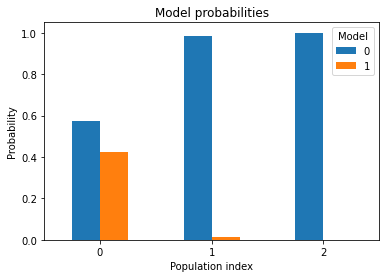
history.get_model_probabilities() argument or by using the plot_model_probabilities() function. We obtain probabilities in favor of model zero for all runs of the ABC-SMC algorithm. In the first run, model one has a probability of around \(1/3\). In the second, run model one is already classified as being very unlikely by assigning a probability of around \(0.2\%\). Thus, the algorithm chooses the true model already after only two runs.[129]:
model_probabilities = history_selection.get_model_probabilities()
model_probabilities
[129]:
| m | 0 | 1 |
|---|---|---|
| t | ||
| 0 | 0.574000 | 0.426000 |
| 1 | 0.984948 | 0.015052 |
| 2 | 1.000000 | 0.000000 |
Figure 12 - Model selection probabilities
[130]:
plot_model_probabilities(history_selection)
[130]:
<AxesSubplot:title={'center':'Model probabilities'}, xlabel='Population index', ylabel='Probability'>
# 4 Concluision
[ ]: